
Our Research
Areas of Research
Our research spans a wide range of topics related to human development, communication, memory, and legal decision-making. Examples of areas we investigate include:
- Adolescents’ memory narratives and how young people recall and communicate past experiences
- Investigative interviewing techniques for adolescents and ways to improve youth interviews
- Factors that influence children’s honesty, lie-telling, and disclosure decisions
- Disclosure and recantation of child maltreatment allegations
- Disclosure and recantation of child maltreatment allegations
- Individual differences in children’s memory, and suggestibility
- Parent-adolescent discussions and how teens make legal decisions
- The impact of the COVID-19 pandemic on adolescents’ memories and experiences
- Interpreter-mediated interviews with youth and communication across languages
- Strategies for improving investigative interviews and interrogations involving children and adolescents
- Social, developmental, and contextual factors that shape youth perspectives and decision-making
- How older adults maltreatment is conceptualized
- Police interactions with older adults
(These represent only some of the topics explored in the DCC Lab, with research interests continuing to evolve as new projects and collaborations emerge.)
Current Research Projects
Honesty and Dishonesty in Sibling Relationships
Our current project looks at the socio-motivational influences of children’s lie-telling in the context of sibling dyads ages 7–12. We are specifically interested in whether younger siblings will be honest or dishonest about their older siblings’ behaviour.
Lead Researchers: Dr. Lindsay Malloy, Ontario Tech University; Dr. Angela Evans, Brock University
Age Group: Youngest child ages 7 to 9 with a sibling 2 to 3 years older
Participation Status: Actively Recruiting. Email us at dcclab@ontariotechu.ca to participate.

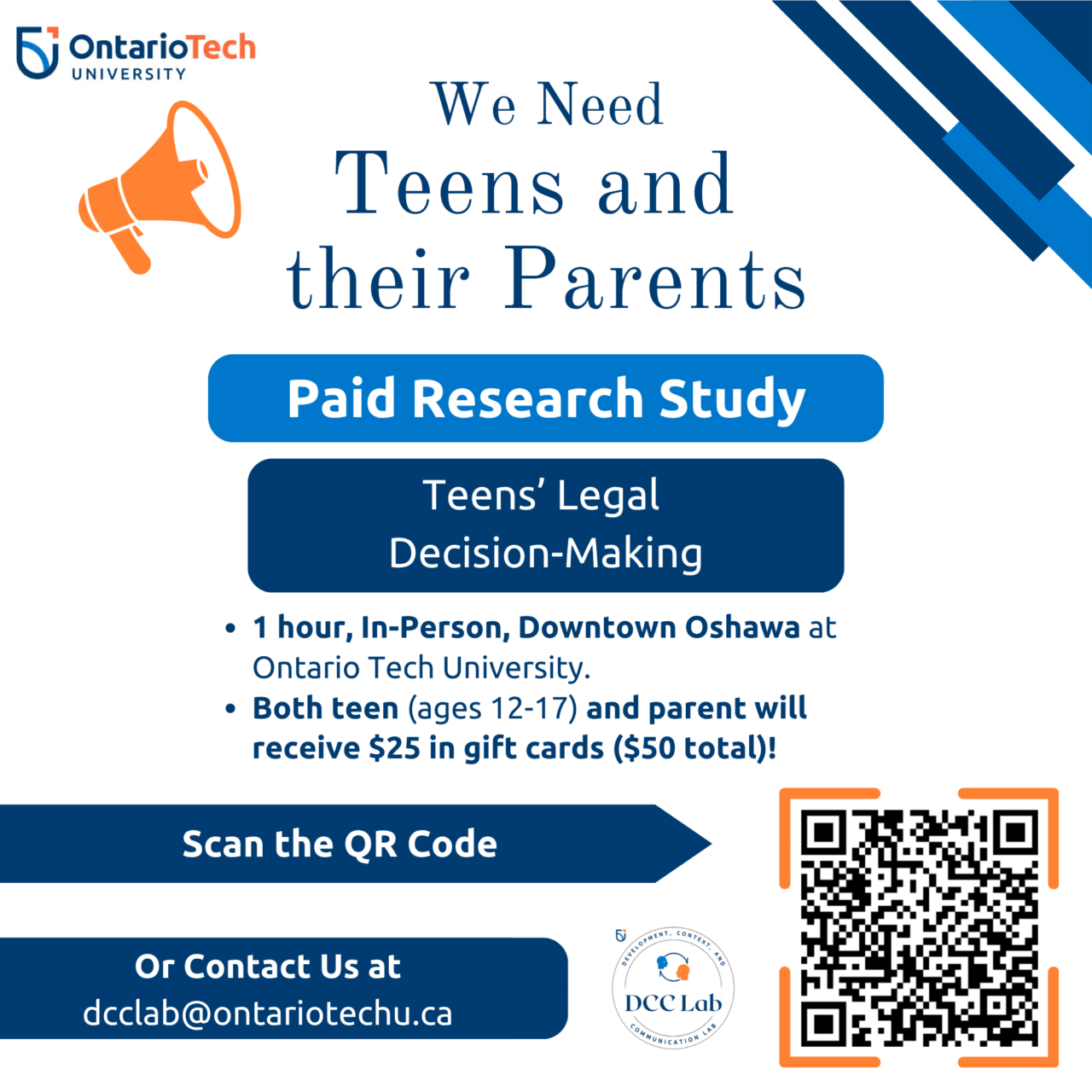
Teens’ Legal Decision Making
Research regarding parent-child discussions concerning legal decisions is minimal. This study assesses how teens and adults make legal decisions in a computer simulation task. Ultimately, this research aims to provide guidance to professionals who work with teens and parents in legal situations.
Student Lead: Kaiden Kaba, MSc Student
Age Group: 12 to 17
Participation Status: Actively Recruiting. Email us at dcclab@ontariotechu.ca to participate.
Understanding Investigative Interviews with Youth
The overarching research goal is to understand the experiences of investigative/forensic interviewers who interview youth in Canada. The project aims to understand the training and experiences of individuals who conduct forensic interviews with youth; explore the methods and procedures they use for interviewing youth; learn about the challenges and successes they face; and uncover interviewers’ recommendations for future policy and research development on interviewing youth to better support their work.
Student Lead: Sydney Spyksma, PhD Student
Participant Eligibility: Forensic/Investigative Interviewers in Canada; Has experience interviewing children and teens
Participation Status: Recruitment Information Coming Soon
Interpreters’ Experiences in Canada
Language interpretation in forensic contexts is an immensely important service that has rarely been researched. With regular exposure to traumatic information, it is important to understand how interpreters are impacted by these disclosures and how they manage work-based stress. This study aims to understand the workplace environment, the impact on interpreters’ well-being, and the factors that reduce the risk of developing symptoms of secondary traumatic stress for language interpreters in Canada.
Student Lead: Tyler Szusecki, MSc Student
Participant Eligibility: Working Canadian Interpreters
Participation Status: Recruitment Has Ended
Interviewing Youth about their COVID-19 Pandemic Memories
This project examines adolescents’ memories of prolonged events, including positive and negative experiences during the COVID-19 pandemic. It also addresses limited research on adolescents’ understanding and involvement in investigative interviews. Specifically, the study explores adolescents’ engagement with pre-interview ground rules, their use of these instructions within a typical child interview protocol, and their perceptions of the interview process.
Student Lead: Sydney Spyksma, PhD Student
Age Group: 12 to 17
Participation Status: Recruitment Has Ended